
Close gaps in sign-in, admin access and sharing.
Configure and test agreed access, account and application-permission changes.
You keepEnforced settings, test results and an exception register.
Delivered on Microsoft 365 and Entra ID
Workplace & Security
Fewer open doors, access that ends when a role ends, devices ready on day one and shared files with an owner. When the platform itself has to change, the move is planned and checked.
First conversation free. Scope and price in writing before any access.
Delivered on Microsoft 365.
Completed project: SharePoint migration troubleshootingA change, acceptedIllustration
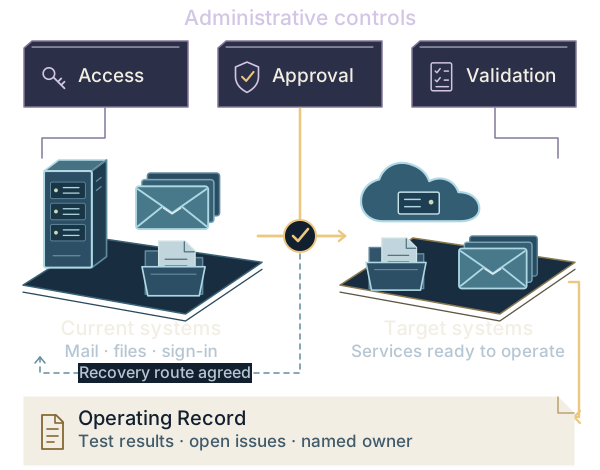
Tested firstAccess, approval and validation controls sit above the move. The recovery route is agreed before mail and files change, and the operating record with test results, open issues and a named owner is what your team keeps.
Seven kinds of job
Each job has its own checks and its own handover. Choose the one that matches what is happening; the map shows how they fit together.
Configure and test agreed access, account and application-permission changes.
You keepEnforced settings, test results and an exception register.
Delivered on Microsoft 365 and Entra ID
Define and configure agreed access requests, reviews, lifecycle rules and privileged access.
You keepAn access model, configured controls and ownership instructions.
Delivered on Microsoft Entra ID Governance
Scope the applications, configure the connection and access policies, and test a pilot.
You keepA tested access path and an agreed basis for rollout.
Delivered on Microsoft Entra Private Access
Configure agreed enrollment, applications and device policies.
You keepConfigured devices, deployment checks and operating instructions.
Delivered on Microsoft Intune
Agree the structure, correct scoped permissions and organize the working spaces.
You keepAn agreed structure with ownership and access checks.
Delivered on SharePoint and Teams
Review the agreed content and permissions, correct approved gaps and test the pilot.
You keepChange records, pilot findings and remaining decisions.
Delivered on Microsoft 365, Purview and Copilot
Choose the source-to-destination route and agree what moves and how it is checked.
You keepA scoped move with validation and handover.
Delivered on Microsoft 365
What you getAgreed settings and access rules, tested, with instructions your team can follow.
Completed project · Migrations
After a move to SharePoint, file differences and access issues needed investigation. Sync behavior and long project paths were part of the problem.
Anonymized completed project. Some exceptions remained; the reports do not show that every file was recovered.
First conversation free. Scope and price in writing before any access.
System guide · what this handover contained
Constructed file-check record · example paths only
Illustrative sample · constructed example
Reconciliation excerpt · constructed project folder
Selected check
| Record | Evidence or responsibility | Sample review |
|---|---|---|
| Source item | Projects / Sample project / Drawing register.pdf | Path exception open |
| Destination | SharePoint / Projects / Drawing register.pdf | Transfer awaiting correction |
| Access | Project member allowed; unrelated pilot user denied. | Test pending |
| Existing links | Keep the old-to-new path and links needing an update. | Owner review required |
This is one constructed item. No total migrated, success percentage or client file is represented.
Constructed row using the documented reconciliation method. It is not a recovered client file or an aggregate success rate.
Microsoft 365 security hardening
Fix the selected sign-in, administrator, sharing and application-consent gaps. Test changes before enforcement and record the exceptions that remain.
Every approved change gets a test result and a change record.
Scheduled hardening. Incident response, continuous monitoring and a wider data-protection program have separate scopes. Features depend on your licenses.
Identity governance · Microsoft Entra
Give employee, guest and administrator access a defined request, approval, review and removal process. Start with the people, applications and roles in scope.
Administrator access has its own rules. Scope eligible roles, activation and review through Privileged Identity Management (PIM).
You keepThe access model, configured control register, test record and instructions for owners and reviewers.
Discuss identity governanceHR sources, app provisioning, removal rules and license requirements are agreed first. This does not automatically manage every application or replace your business’s approval decisions.
Microsoft Entra Private Access
Scope access to named internal applications and resources. Configure the connection and access rules, then prove the path with a pilot before a wider rollout.
Private network
You keepThe application and connection map, configuration record, pilot results and operating instructions.
Discuss a Private Access pilotEntra Private Access is a separate capability with license and deployment prerequisites. App compatibility and client support are checked first; a pilot does not promise replacement of every VPN use case.
Connected systems and complex moves
Choose the project that matches the change ahead. Each scope sets out the work, the approvals needed, the documents you keep and the checks required for completion. Further work needs a separate agreement.
Illustrative sample · constructed example
Review excerpt · privileged access ownership
Selected check
| Record | Evidence or responsibility | Sample review |
|---|---|---|
| Privileged assignment | Keep the assignment reference and evidence date. | Assignment observed |
| Purpose and owner | Verify why the access exists and who owns it. | Owner unknown |
| Next decision | Agree whether a separately scoped change is needed. | Evidence gap |
| Production | Record the review without changing access. | No settings changed |
The review produces a decision and record. Any implementation needs its own agreed scope.
Illustrative sample. This review produces decisions and a record; it does not change production settings.
Assessment
A sign-in change or acquisition has raised questions about which directory manages accounts and who has administrator access.
Approved identity corrections, federation exit or application modernization under a separately defined scope.
Illustrative sample · constructed example
Exchange Online path · application relay before server retirement
Selected check
Exchange Online path · application relay before server retirement
| Dependency | What has to be established | Sample review |
|---|---|---|
| Mailboxes | Check the agreed move to Exchange Online. | Move checked |
| Printer relay | Verify the replacement sending route with the printer owner. | Old server still referenced |
| Directory authority | Confirm how identities will be managed after the change. | Separate review required |
| Archives and retirement | Resolve archive dependencies and approve retirement steps. | Retirement not approved |
One successful relay test cannot authorize the server retirement.
Illustrative Exchange Online destination. The alternative Exchange Server Subscription Edition path is scoped separately. A relay test does not prove that directory or archive dependencies are resolved.
Program
Exchange must retire, but applications, relay, recipient management or shared access still depend on it.
Source retirement and transfer of the accepted messaging runbook after the exit decision is approved.
Illustrative sample · constructed example
Illustrative merger · project coordinator
Selected check
Illustrative merger · project coordinator
| Record | Evidence or responsibility | Sample review |
|---|---|---|
| Domain and identity | Both owners agree the domain release and sign-in timing. | Transition not approved |
| Mailbox | Test the person’s sign-in and agreed mailbox in the target. | Target account exists |
| Project Team | Check membership and the user’s actual task separately. | Access review pending |
| OneDrive | Verify its agreed migration path and acceptance record. | Separate workload check |
Accept each workload on its own evidence; tenant access alone does not complete the move.
Illustrative sample. Workloads have different migration paths; a mailbox result is not a Teams or OneDrive result.
Program
A separation, acquisition or consolidation puts a date against tenant, domain and ownership decisions.
Stabilization, remaining workload migration or source decommissioning only after the corresponding acceptance decision.
Illustrative sample · constructed example
Reconciliation excerpt · constructed project folder
Selected check
| Record | Evidence or responsibility | Sample review |
|---|---|---|
| Source item | Projects / Sample project / Drawing register.pdf | Path exception open |
| Destination | SharePoint / Projects / Drawing register.pdf | Transfer awaiting correction |
| Access | Project member allowed; unrelated pilot user denied. | Test pending |
| Existing links | Keep the old-to-new path and links needing an update. | Owner review required |
This is one constructed item. No total migrated, success percentage or client file is represented.
Constructed row using the documented reconciliation method. It is not a recovered client file or an aggregate success rate.
Program
A legacy archive must retire while retention, holds, permissions or discovery obligations remain unresolved.
Controlled migration and source retirement after the readiness, pilot and acceptance gates are satisfied.
If you do not yet know where to start, review administrator access, sensitive data and ownership through the Microsoft 365 risk review.
Complete the agreed tests, record outstanding issues and hand over to the named owner.
In scope: Pilot · Migration waves · Rollback · Reconciliation · Investigation evidence · Security validation · Operating Record · Named ownership
Agree who manages tenants, domains, account synchronization and administrator access before the move.
Tenant control · Hybrid identity · Administrative authority · Federation · Enterprise applications · M&A and cross-tenant architecture
Decide which user, guest and application access stays, changes, expires or is removed.
Conditional Access · MFA · PIM · External identity · Device compliance · Application identities · Identity governance
Plan and test email and connected services before, during and after the cutover.
Exchange · Messaging · DNS · Certificates · Relay · Collaboration · Endpoint operation · Recovery
Compare the destination files, access and retention settings with the agreed requirements.
Archives · Purview · DLP · Retention · eDiscovery · SharePoint · Teams · Copilot data exposure
Complete the agreed tests, record outstanding issues and hand over to the named owner.
Pilot · Migration waves · Rollback · Reconciliation · Investigation evidence · Security validation · Operating Record · Named ownership
Illustrative architecture · the project scope is agreed for your environment.
Also within this practice
Each one is a defined project with its own checks and handover, not an add-on to the others.
Security operations & investigations
We review the available sign-in, email, device and audit records for an agreed question. Findings state what the records show, what is missing and who needs to act.
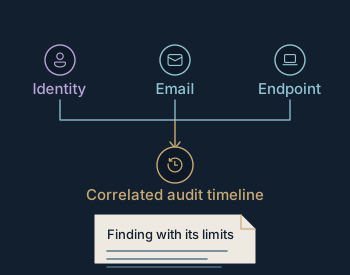
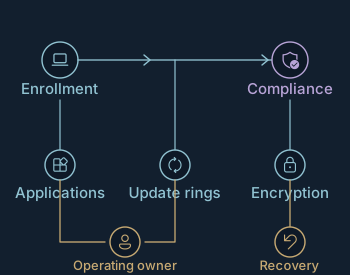
Endpoint control
A device has to remain manageable through application changes, policy updates, recovery and transfer to its operator.
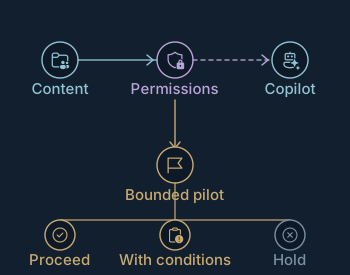
Copilot & AI governance
Review sensitive files, external sharing and inherited permissions. Use the findings to define the pilot and the checks needed before more people join.
How you know the work is good
The method is written down, the sample records open and the demo can be broken on purpose. Read it the way your technical owner would.
A first conversation, free. An agreed scope with a named technical lead in the proposal. The price fixed in writing before we are given access. Checks before handover.
How we workRelease checks, access test matrices and ownership maps. Constructed inspection records on the service pages show the standard before you buy.
See sample deliverablesA System guide: what was agreed, what changed, what was tested and what remains open. With it, the scripts and check results behind the work.
Tell us why the change is needed, which systems are involved and your deadline. We say whether the project can be quoted now or needs a separately priced review first.
Your team names a sponsor to approve the work and a technical owner to coordinate it. The statement of work names our technical lead, each party’s responsibilities and the tests needed before handover.
How a project runsFirst conversation free. Scope and price in writing before any access.