Part of Systems & Infrastructure

Private AI & high-performance infrastructure

Decide whether private AI is worth building before buying hardware.

For a defined use case, we compare a dedicated AI platform with hosted alternatives: the data it needs, the computing capacity, the expected demand, the cost and who would run it.

First conversation free. Scope and price in writing before any access.

Delivered on Azure, hosted platforms or hardware you own.

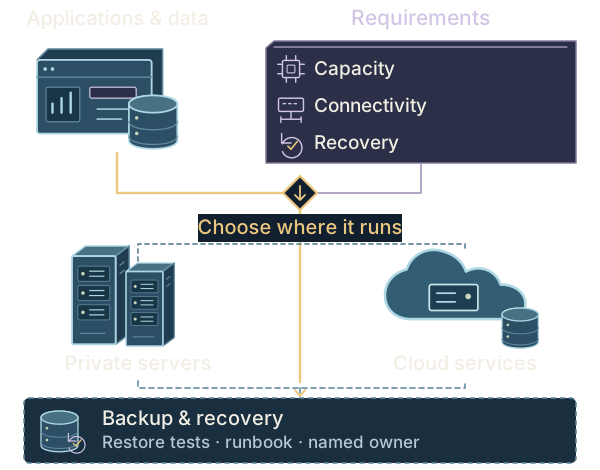
Choose where it runsIllustration

Choosing where an application runs: the application and its data with capacity, connectivity and recovery requirements, on-site servers and cloud services as the options, and a backup and recovery plan with restore tests, a runbook and a named owner.

Costed firstThe review works out what the workload needs to keep running, and what that costs to own, before any hardware is ordered.

Illustrative sample · constructed example

A private model still needs a workload and an operating owner.

Illustrative feasibility check · internal document assistant

Decision input

Is the data boundary a requirement, and can the team operate the private option?

Private AI / feasibility criteriaIllustrative
CONCEPT / INFERENCE & DATA01 / DESIGN STUDY
Employee questionIdentity · approved document scope
Proposed private boundary
Retrieval + inferenceModel · context · request limits
Scoped document retrieval
Approved document storePermissions · index · retention
↳ Recovery design Restore target + operating owner
External connectionCheck every data crossing
Hosted option
Hosted inferenceService terms · task quality
Eligible only if the data terms meet the agreed boundary.
DECISION POINTAgree requirements before recommending the destination.
Private AI / feasibility criteria: constructed inspection record
RequirementDesign implicationSample review
Data boundaryIdentify whether prompts, retrieved documents or outputs may leave it.Boundary unknown
Task qualityCompare the same questions and documents across eligible options.Evaluation required
Demand and capacityMeasure model memory, concurrent demand and response requirements.Measurement required
Operation and recoveryName who patches, monitors and restores the platform.Operating plan needed

Conceptual design. A private boundary does not establish model quality, affordable capacity or operational readiness.

Evidence
Data classification, peak demand, model quality and operating capacity are unresolved.
Decision
Insufficient evidence to recommend
Next action
Define the task and boundary, measure demand, and test quality before comparing costs.

Illustrative comparison. No procurement recommendation, achieved saving or fabricated capacity result. Design and deployment require separate scope.

Engagement sequence

Check the case first.
Agree each next step.

The review may recommend proceeding, changing the approach or waiting. Platform design, supplier review and deployment testing are agreed separately.

The architecture review

One assessment across business, platform, and operations.

We review how the platform would use your data, connect to other systems, control access and operate day to day. Expand the list to see the ten areas covered.

Inspect the ten assessment areas
  1. 01

    Business outcome

    Workload, success measure, service level, and investment threshold.

  2. 02

    Governance, risk, compliance

    Policy boundary, risk owner, data obligations, and approval path.

  3. 03

    Operations and ownership

    Who runs the platform, the support included, operating instructions and who approves changes.

  4. 04

    Monitoring and evaluation

    Model quality, drift, telemetry, cost, safety, and acceptance evidence.

  5. 05

    Integration and orchestration

    Workflows, agents, APIs, queues, failure modes, and human control points.

  6. 06

    Models and platform

    Model mix, runtime, portability, licensing, and platform exit conditions.

  7. 07

    Compute and capacity

    Training and inference demand, GPU topology, thermal envelope, and growth headroom.

  8. 08

    Data

    Sources, residency, lineage, storage IOPS, retrieval, retention, and recovery.

  9. 09

    Identity and access

    Role-based access and isolation for people, services, agents, and privileged operations.

  10. 10

    Network and security boundary

    Segmentation, RoCE or InfiniBand fabric, ingress, egress, and trust boundaries.

What we need from you

A sponsor for the decision.
An owner for the result.

Bring a defined use case or workload, an executive sponsor, and an internal technical owner. Existing architecture, capacity estimates, or supplier proposals provide a useful starting point.

The scope states the inputs, assessment methods, assumptions, deliverables, fixed fee, and acceptance criteria. AZ Innovations is responsible for the architecture and delivery coordination agreed in the scope. Licensed engineering and specialist trade work is performed by qualified delivery partners where required.

How a project runs

How you know the work is good

Judge it by what you can inspect.

The method is written down, the sample records open and the demo can be broken on purpose. Read it the way your technical owner would.

How a project runs

A first conversation, free. An agreed scope with a named technical lead in the proposal. The price fixed in writing before we are given access. Checks before handover.

How we work
What is checked

Release checks, access test matrices and ownership maps. Constructed inspection records on the service pages show the standard before you buy.

See sample deliverables
What you keep

A System guide: what was agreed, what changed, what was tested and what remains open. With it, the scripts and check results behind the work.

Before procurement

Know the cost and operating needs before you buy.

Discuss your AI platform requirements

Share the AI use case, supplier proposal or capacity question, and your deadline. We explain what information is needed to compare the options.

First conversation free. Scope and price in writing before any access.