Microsoft 365 Architecture & Delivery

When Microsoft systems change, the business still has to run.

We plan and deliver Microsoft 365 migrations, tenant separations, Exchange retirement and identity changes. The scope covers the connected services, access and data that need attention, with agreed tests and operating instructions for your team.

  1. Current systems
  2. Planned changes
  3. Tested result
Administrative controlsAccessApprovalValidationAdministrative controlsAccessApprovalValidationSource directoryAccounts · domainsTarget directoryEntra ID · tenantDIRECTORYDIRECTORYDirectorysynchronizationDomains & federationWho controls sign-inApp connectionsWhich directory they useNamed ownerWho can change the tenantSourcedirectoryTargetdirectoryDIRECTORYDIRECTORYDirectorysynchronizationDomains & federationWho controls sign-inApp connectionsWhich directory they useNamed ownerWho can change the tenantPeople & accountsWorkforce · guestsDevices & appsCompliance · permissionsConditionalAccessAuthenticationMFA and guest accessApp permissionsSeparate from user accessPrivileged access (PIM)Time-bound activationPeople &accountsDevices &appsConditionalAccessAuthenticationMFA and guest accessApp permissionsSeparate from user accessPrivileged access (PIM)Time-bound activationExchange ServerMailboxes · app emailExchange OnlineCloud mailboxesMailroutingDNS & certificatesCheck the mail routeRelay & connectorsTest application emailRecovery pathAgree when to go backExchangeServerExchangeOnlineMailroutingDNS & certificatesCheck the mail routeRelay & connectorsTest application emailRecovery pathAgree when to go backEmail & archivesFiles · existing accessSharePoint & TeamsContent · destination accessPurviewrequirementsRetention & holdsPreserve agreed obligationseDiscovery & DLPCheck search and policiesPermissionsReview Copilot exposureEmail &archivesSharePoint& TeamsPurviewrequirementsRetention & holdsPreserve agreed obligationseDiscovery & DLPCheck search and policiesPermissionsReview Copilot exposurePilot & migrationWork in agreed groupsTested servicesReady for owner reviewAcceptancechecksRecovery route agreedOperating RecordTest results · open issues · recovery stepsNamed owner · operating instructionsPilot &migrationTestedservicesAcceptancechecksRecovery route agreedOperating RecordTest resultsOpen issues and recovery stepsNamed owner and instructions

Complete the agreed tests, record outstanding issues and hand over to the named owner.

In scope: Pilot · Migration waves · Rollback · Reconciliation · Investigation evidence · Security validation · Operating Record · Named ownership

01 Authority

Agree who manages tenants, domains, account synchronization and administrator access before the move.

Tenant control · Hybrid identity · Administrative authority · Federation · Enterprise applications · M&A and cross-tenant architecture

Directory authority
Document which directory manages each account, the destination tenant and who can change each domain before the move.
Synchronization & applications
Map synchronization, federated sign-in and connected applications to the directory that will manage them.
Administrative ownership
Name the owner of each administrative role and the person who accepts the transfer of tenant control.
02 Access

Decide which user, guest and application access stays, changes, expires or is removed.

Conditional Access · MFA · PIM · External identity · Device compliance · Application identities · Identity governance

People & devices
Map workforce identities, devices, authentication methods and guest access to Conditional Access requirements in the target estate.
Privilege & applications
Separate privileged identities from everyday access. Define PIM activation, emergency access and the permissions retained by application identities.
External trust
Decide which cross-tenant access and federation paths are preserved, replaced, time-bound or removed, with an owner for each decision.
03 Continuity

Plan and test email and connected services before, during and after the cutover.

Exchange · Messaging · DNS · Certificates · Relay · Collaboration · Endpoint operation · Recovery

Mail routing
Trace Exchange Server and Exchange Online coexistence through DNS, certificates, SMTP relay and connectors before changing the active route.
Connected services
Test shared mailboxes, delegation, application-generated email, collaboration and endpoint dependencies alongside user mail flow.
Continuity checks
Validate communication during coexistence, at cutover and after the route changes. Keep a defined path back while exit criteria remain unmet.
04 Information

Compare the destination files, access and retention settings with the agreed requirements.

Archives · Purview · DLP · Retention · eDiscovery · SharePoint · Teams · Copilot data exposure

Content & permissions
Map mailboxes, legacy archives, SharePoint, OneDrive and Teams content with the permissions that determine who can use it.
Information obligations
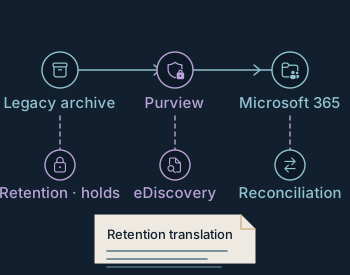
Account for Microsoft Purview, retention, holds, DLP and eDiscovery dependencies before content is moved or a source is retired.
Reconciliation & AI exposure
Compare source and target content, permissions and obligations. Record differences, route exceptions to the information owner, and examine what Copilot could surface.
05 Acceptance

Complete the agreed tests, record outstanding issues and hand over to the named owner.

Pilot · Migration waves · Rollback · Reconciliation · Investigation evidence · Security validation · Operating Record · Named ownership

Change control
Agree checks before each pilot or migration group proceeds, including when to stop and which recovery steps remain possible.
Acceptance control
Compare source and destination, run the agreed security tests and review remaining issues. Approval to make a change is separate from approval of the finished result.
Operating ownership
Give the named owner an Operating Record: the approved design, test results, findings and their limits, open issues and operating instructions.

Illustrative architecture · the project scope is agreed for your environment.

Defined engagements

A defined project, with clear completion checks.

Choose the project that matches the change ahead. Each scope sets out the work, the approvals needed, the documents you keep and the checks required for completion. Further work needs a separate agreement.

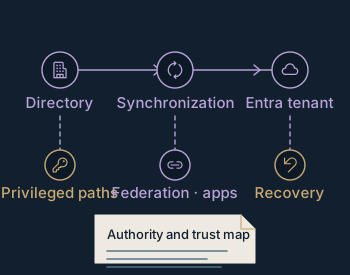
Illustrative identity authority, trust and recovery map. Not a client artifact.
Illustrative assessment pattern. Not a client artifact.

Assessment · Authority

Hybrid Identity & Privileged Access Review

A sign-in change or acquisition has raised questions about which directory manages accounts and who has administrator access.

Decision
Which account sources, sign-in connections and administrator permissions should stay, change or be removed?
What is included
Review the agreed directories, synchronization, federation, administrator access, applications and recovery requirements. This is a review; changes to live systems are scoped separately.
What your team keeps
A map of account ownership and sign-in connections, access findings, recovery requirements and a prioritized design recommendation.
Complete when
The agreed account and sign-in paths have been reviewed. Findings, missing evidence, priorities and design recommendations are recorded and reviewed with named owners.
After the decision is approved

Approved identity corrections, federation exit or application modernization under a separately defined scope.
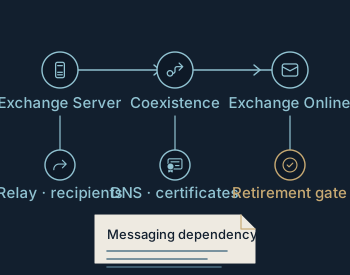
Illustrative messaging dependency and retirement plan. Not a client artifact.
Illustrative program pattern. Not a client artifact.

Program · Continuity

Exchange Retirement & Mail Migration

Exchange must retire, but applications, relay, recipient management or shared access still depend on it.

Decision
What must change before the legacy messaging path can be switched off?
What is included
Review the agreed mail systems, account management, domains, DNS, certificates, application mail and connectors. Plan the pilot and cutover with approval checks and recovery limits.
What your team keeps
A mail-system map, a plan for each application that sends email, pilot and cutover steps, mail-flow tests and the server-retirement decision.
Complete when
The agreed sign-in and mail-flow tests pass. Remaining issues have an agreed action and owner before server retirement is approved.
After the decision is approved

Source retirement and transfer of the accepted messaging runbook after the exit decision is approved.

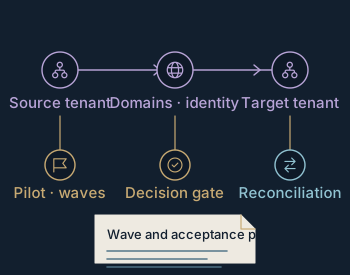
Illustrative migration wave and acceptance plan. Not a client artifact.
Illustrative program pattern. Not a client artifact.

Program · Authority

Tenant Separation & Consolidation

A separation, acquisition or consolidation puts a date against tenant, domain and ownership decisions.

Decision
Which accounts, applications and data move or stay, and who signs off on the result?
What is included
The agreed accounts, domains, applications and data, including retention requirements and temporary connections between tenants. Start with a pilot, then migrate in groups with documented recovery limits.
What your team keeps
Maps of both environments, account and administrator ownership, the migration schedule, source-to-destination checks and handover instructions.
Complete when
The agreed applications, data, permissions and retention settings are checked in the destination. Named owners review outstanding issues and take over administration.
After the decision is approved

Stabilization, remaining workload migration or source decommissioning only after the corresponding acceptance decision.

Illustrative source and target retention translation. Not a client artifact.
Illustrative program pattern. Not a client artifact.

Program · Information

Archive Migration & Retention Controls

A legacy archive must retire while retention, holds, permissions or discovery obligations remain unresolved.

Decision
Which records may move or be retired, which retention and hold requirements apply, and how will the move be checked?
What is included
The agreed archive sources, custodians, retention intent, holds, permissions, target Purview design, migration exceptions and reconciliation. Legal interpretations remain with the client’s authorized legal or information owner.
What your team keeps
An archive inventory, a mapping of existing retention rules to the proposed Purview settings, hold requirements, open issues and migration checks.
Complete when
Source and destination records, permissions and retention requirements have been compared. Named information owners approve remaining issues and the archive-retirement decision.
After the decision is approved

Controlled migration and source retirement after the readiness, pilot and acceptance gates are satisfied.

If you do not yet know where to start, review administrator access, sensitive data and ownership through the Microsoft 365 risk review.

Security operations & investigations

Know what happened, and what the logs can prove.

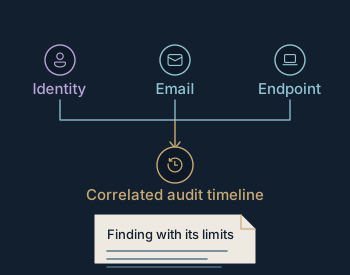
We review the available sign-in, email, device and audit records for an agreed question. Findings state what the records show, what is missing and who needs to act.

What happened, what remains uncertain, and who must act?
In scope
Scope can include Defender XDR and Sentinel setup checks, detection coverage, KQL queries and alert responsibilities. Investigations compare the available logs and state their limits.
What your team keeps
The log sources reviewed, an event timeline, findings with confidence and limitations, and response actions with named owners.
Boundary
Readiness work is separate from monitoring. No continuous monitoring, 24/7 SOC or open-ended emergency response is offered.
Illustrative evidence correlation: identity, email and endpoint signals reach one finding with its limits.
Illustrative pattern. Not a client artifact.

Endpoint control

Device setup is only the start.

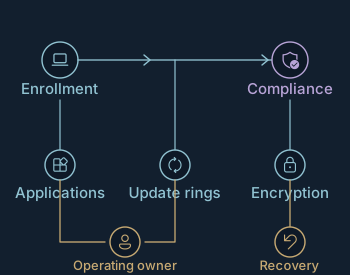
A device has to remain manageable through application changes, policy updates, recovery and transfer to its operator.

Can the device be deployed, kept compliant and recovered under named ownership?
In scope
Define Intune and Autopilot enrollment, application deployment, update groups, compliance rules, encryption recovery and support responsibilities.
What your team keeps
Enrollment and policy architecture, pilot results, application and update ownership, recovery evidence and an operating runbook.
Boundary
Endpoint work is delivered as defined projects with a documented handoff. A rollout is scoped against the actual device estate, never assumed from a device count.
Illustrative device operating model: enrollment, compliance, applications, updates and recovery connect to an operating owner.
Illustrative pattern. Not a client artifact.

Copilot & AI governance

Check what Copilot users can access.

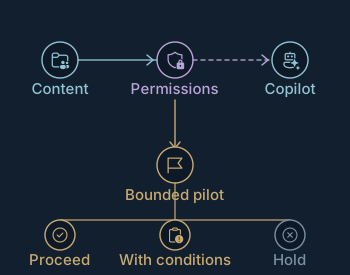
Review sensitive files, external sharing and inherited permissions. Use the findings to define the pilot and the checks needed before more people join.

Proceed, proceed with conditions, or hold?
In scope
The agreed Copilot use case, file permissions, sensitive data, Purview requirements, guest and application access, and pilot completion checks.
What your team keeps
Exposure map, permission corrections, use-case and pilot criteria, exceptions, ownership and a recorded go/no-go decision.
Boundary
Readiness and discovery work establish the decision. They are not presented as evidence of a delivered Copilot rollout or a private AI deployment.
Illustrative readiness decision: the permission boundary determines whether the bounded pilot proceeds, proceeds with conditions, or holds.
Illustrative pattern. Not a client artifact.

Selected delivery records

What the client kept.

These anonymized records describe completed work and the evidence retained at handover. Published scope is not delivery evidence; each record states its own limits.

Read the delivery record

Migration rescue

SharePoint migration troubleshooting and reconciliation

Anonymized delivered engagement

Migration as-built, issue records, reconciliation scripts and validation reports. Client names, file paths and identifying data are withheld.

GoDaddy exit

Provider exit: administrative control and messaging continuity

Representative engagement example

Representative scope and handover structure, informed by an anonymized engagement narrative. Completed migration contracts can be checked separately in the public work history.

Access investigation

Exchange email-forensics work

Publicly documented contract scope

Public completed-contract history on Upwork, linked below for independent review.

Endpoint & cloud work

Intune application packaging and Azure permissions work

Publicly documented contract scope

The public contract titles and separately attributed client feedback, with a link to the original work history.

Start with the business context

What has to change.
What has to keep working.

Request an Architecture Briefing

Tell us why the change is needed, which systems are involved and your deadline. We determine whether the project can be quoted now or needs a separately priced review first.

Your team names a sponsor to approve the work and a technical owner to coordinate it. The statement of work names our technical lead, each party’s responsibilities and the tests needed before handover.

How engagements work